
EMDR
EMDR A leading therapy to leave your trauma in the past
EMDR stands for Eye Movement Desensitisation and Reprocessing.

“The past affects the present even without our being aware of it.”
― Francine Shapiro, creator of EMDR Therapy!
- Anxiety, panic attacks, and phobias
- Chronic illness and medical concerns
- Depression and bipolar disorder
- Dissociative disorders
- Violence and all forms of abuse
- performance anxiety
- personality disorders
- ptsd & other trauma and stressors
- sexual assault
- eating disorders
- grief & loss
- pain
- sleep disturbance
Benefit 1
Benefit 2
Benefit 3
Stephanie’s Story…
Stephaine M.
San Diego, CA
What does EMDR do to your brain?
When you experience trauma in your life, your neuro-network gets ‘stuck.’ EMDR activates and engages your brain so it essentially gets ‘un-stuck.’ Traumatic memories are stored differently. They are held onto by your instinctive nature to ward off similar threats or danger. So your brain is always hyper-vigilant. You are constantly on the lookout for anything that could pose a threat to you. Being in a state of constant fight or flight is incredibly draining not only mentally, but physically as well.
– Traditional therapy works from the top-down (rational mind to your instinctive mind) – EMDR, however, is the opposite.
– EMDR taps into the instinctive mind, where the trauma lives, while the person is present and reliving the traumatic memory in a safe and guided atmosphere.
– While experiencing EMDR, your therapist will have you recall a traumatic memory, while watching a finger waved from the left eye to the right, back and forth, a lightbar with a dot you follow, EFT tapping, or even sounds. This action appears to connect the left and right brain in a different way, while at the same time connecting you to the present. In a way we don’t fully understand yet, this rewrites the trauma memory and substantially diminishes or even erases the associated distress. The memory becomes ‘that difficult thing that happened in my life’ and no longer the all-consuming deeply affecting trauma.
Post-Traumatic Stress Disorder
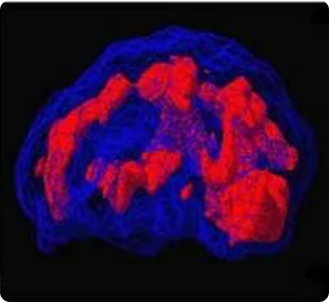
Before
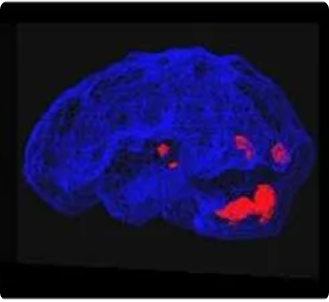
After
The left photo shows a woman with PTSD.
The right photo shows the same woman after four 90-minute EMDR Therapy sessions.
The red areas indicate over-activity in the brain.
Photo by Dr. Daniel Amen
Why should I choose EMDR with
Peter Cellarius?
In many repeated studies, the evidence highlighted that when individuals participate in EMDR, they can experience the advantages and benefits of psychotherapy that would typically take years to see and progress through. Individuals that experience EMDR with Peter are able to reprocess those traumatic memories until it is no longer psychologically disturbing.
Anyone can experience or go through trauma. EMDR is commonly considered one of the most effective treatments for individuals suffering from PTSD. The treatment protocols are established on reviews that assess the research of mental health treatments that have been established as evidence-based. Peter specialises in EMDR by using his fingers for eye movement and butterfly tapping to conduct the session.
This treatment has been endorsed by the World Health Organization (WHO), the U.S. Department of Veteran Affairs/ Department of Defense, the American Psychiatric Association (APA), the International Society for Traumatic Stress Studies (ISTSS), The Cochrane Database of Systematic Reviews (TCDSR), among many other health organisations.
Let's start working
together!